AUTHORS
Kevin R. Glover, PhD1; Katherine Layton, MD2; Kristen A. Briggs, MEd3; Josee Wiedel, MSN4; Christina Harper, PhD5; Rachel N. Burton, MS1; Zack Tyndall, MBA1; Kathryn Fiddler, DNP6
1Richard A. Henson Medical Simulation Center, Salisbury University, Salisbury, MD
2Undergraduate Medical Education, TidalHealth Peninsula Regional, Salisbury, MD
3Thinking and Doing Program, Wicomico County Public Schools, Salisbury, MD
4Women’s & Children’s Division, TidalHealth Peninsula Regional, Salisbury, MD
5Outdoor Education Leadership, Salisbury University, Salisbury, MD
6Population Health, TidalHealth Peninsula Regional, Salisbury, MD
Corresponding Author
Kevin Glover, krglover@salisbury.edu
Conflict of interest statement
The authors have no conflicts of interest to declare.
Please cite this article as: Glover, K. R., Layton, K., Briggs, K. A., Wiedel, J., Harper, C., Burton, R. N., Tyndall, Z., & Fiddler, K. (2026). Design, Development, Implementation, and Evaluation of Healthcare Simulation Experiences for Elementary Students to Expose Them to Future Rural Healthcare Careers. Simulation Technology & Operations Resource Magazine, 5(1), page-page. ISSN: 3070-3506.
ABSTRACT
Introduction: Exposing rural elementary school students to healthcare careers has been advocated as an important workforce development initiative for decades. However, descriptions of such educational initiatives are scarce, and little is known about the development, implementation, and evaluation of such programs.
Methods: A rural interdisciplinary team used an iterative instructional design process to develop, implement, and evaluate five 1-hour immersive healthcare simulation activities at a university medical simulation center. The activities were designed to help augment the local school district’s “Medical Marvels” curricular unit for 314 third, fourth, and fifth-grade gifted and talented students.
Results: A qualitative analysis of student thank you notes received after the program (n = 249) revealed that the words “enjoy” (n = 131), “fun” (n =120), “interesting” (n = 81), “cool” (n = 69), “loved” (n =47), “amazing” (n = 20), and “awesome” (n = 12) were associated with “learn”, “learned”, or “learning” (n = 415).
Conclusions: Early socialization of underexposed youth in the health sciences can have a substantial impact on their decision to pursue a health professional career, resulting in an increased pipeline of clinical practitioners returning to their local rural communities. The thank you notes received after the “Medical Marvels” activities indicated that the program was well received and may have been a transformational experience for some students.
INTRODUCTION
Declining student interest in the sciences is a concern for economically disadvantaged rural communities that are challenged with recruiting and sustaining an adequate healthcare workforce (Bunce et al., 2009; Daniels et al., 2007; Valla & Williams, 2012). Communities with health professional shortages have higher rates of chronic conditions and shorter life expectancy due to inadequate access to medical and hospital services (Daniels et al., 2007). It has been suggested that people with rural roots who also do part of their health professional training in rural areas are more likely to select rural work locations (Daniels et al., 2007; MacQueen et al., 2017). Early socialization of underexposed youth in the health sciences can have a substantial impact on their decision to pursue a career in the health professions, resulting in an increased pipeline of clinical practitioners back into their local rural communities (Bunce et al., 2009; Valla & Williams, 2012). However, even though exposing rural elementary school students to healthcare careers has been advocated as an important workforce development initiative for decades, descriptions of such educational initiatives are scarce, and little is known about the prevalence and design of such programs (Institute of Medicine, 2005; Jopson et al., 2020). In a scoping review, Jopson et al. (2020) could only identify five publications that described healthcare pathway programs for K-5 students in the US between 1970 and 2017.
METHODS
Program Design and Implementation
A hands-on experiential healthcare learning program was iteratively designed and developed over a six-month period by an interdisciplinary team. The development team included a university-based simulation center director (Instructional Designer), a technology coordinator (Paramedic), a standardized patient coordinator (Exercise Physiologist), four elementary public-school teachers, a pediatric hospitalist, a VP of Public Health, a clinical nurse educator from the local community hospital, and a university faculty member specializing in outdoor leadership.
The program was then implemented by a rural university’s medical simulation center to help augment a local school district’s “Medical Marvels” curricular unit for 314 students enrolled in the gifted and talented elementary school program. The school district is in a federally designated health professional shortage area.
Experiential Learning Program
During the 5-day simulation-based program, groups of 12 to 15 students rotated through five 1-hour immersive activities. Prior to participating in the experiential learning program, parental consent was received, as well as permission to use participating students' photos, videos, and voices for education or marketing purposes. In each activity, students identified, treated, and discussed the probable cause of various disease states using different simulation-based technologies. The five sessions are described below.
In the respiratory session, students worked with a standardized patient wearing a prosthetic lung auscultation simulator to explore the potential causes of emphysema. Then, they walked through treating a pediatric patient hospitalized due to an asthma exacerbation using a robotic pediatric manikin. After initiating a nebulizer treatment, students questioned the simulated grandmother to determine the cause of the asthma attack.
In the virtual anatomy lab session, students explored, identified, and dissected the organs of the digestive and urinary systems on virtual cadavers.
The combined cardiovascular and nervous system session focused on exploring the symptomatic differences between angina and a stroke using a robotic patient manikin.
In the simulated wilderness activity, students learned how to treat a variety of musculoskeletal injuries simulated by standardized patients. This included using found materials in nature to create splints and slings, as well as how to apply direct pressure to control a bleed.
In the simulated kitchen session, students learned how to recognize anaphylaxis and use an Epi-Pen on a pediatric robotic patient manikin. They also learned how to identify potential hazards to children and ways to prevent accidents by using electrical outlet covers and cabinet locks. Finally, students learned how to recognize the signs and symptoms of a choking infant and practiced properly dislodging the obstruction with an infant task trainer.
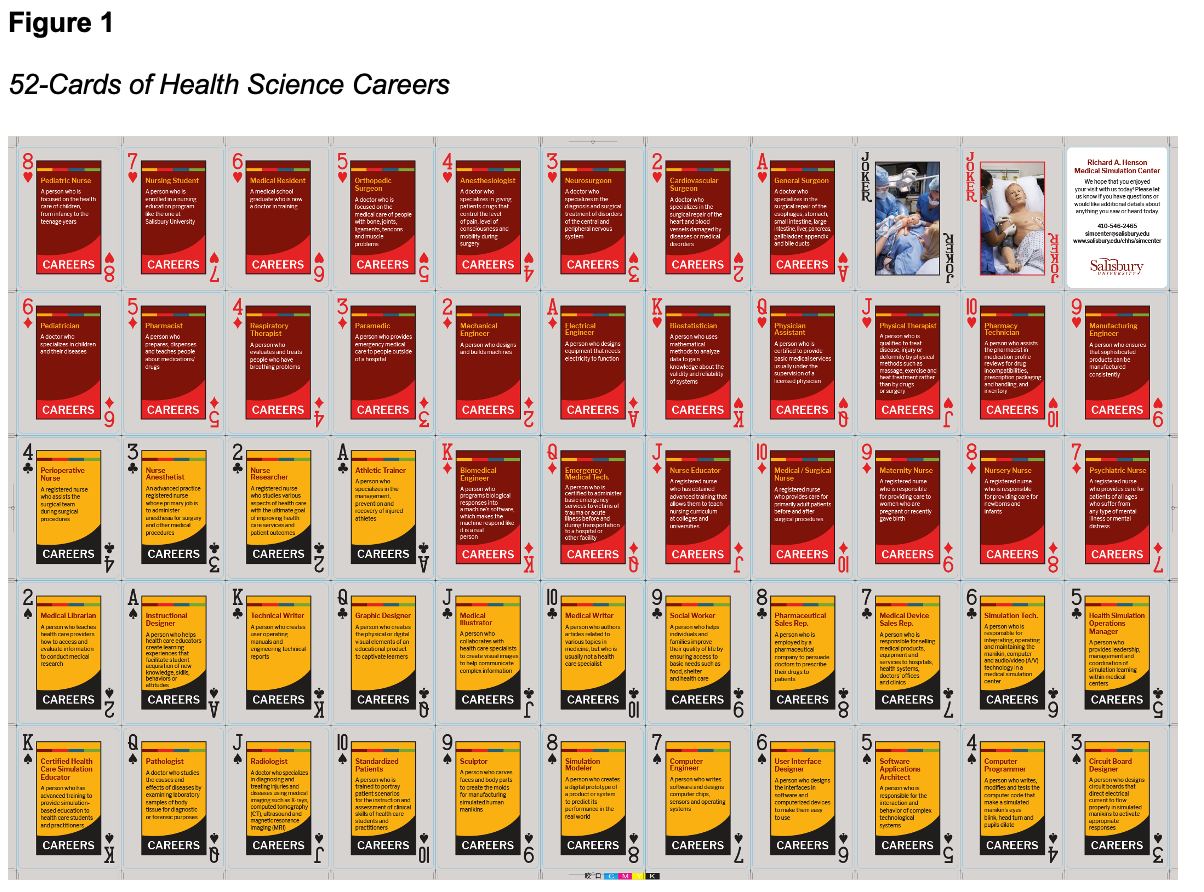
In addition to the formal simulation activities aligned with the school district’s curriculum, a broader range of health sciences career pathways was discussed, such as certified healthcare simulation educator, instructional designer, and health simulation operations manager. To reinforce the diversity of careers in simulation-based health sciences, students received a 52-card deck after each day's activities, with each card showcasing a different profession (Figure 1).
RESULTS
Student Demographics
A total of 290 students from 12 elementary schools participated in the program, with 128 in third grade (44%), 95 in fourth grade (33%), and 67 in fifth grade (23%). The group was 56% male and 44% female. According to school district demographic data, participants identified as White (62%), Asian (12%), Black (9%), Mixed Race (9%), and Hispanic (8%) (Wicomico County Public Elementary School Demographics, n.d.). Twenty-four students from the original cohort of 314 (7.6%) did not participate due to opting out, absence on the day of the program, or no longer being enrolled in the district's gifted program.
Facilitator Demographics
Thirty-two facilitators led the program activities. The majority were female (75%, n=24), predominantly White with one Black facilitator. Male facilitators (25%, n=7) included six White, one Black, and one Hispanic individual. Facilitators came from diverse professional backgrounds: six nurses, five elementary school teachers, five simulation experts, four university faculty members, four standardized patients, two medical doctors, two exercise science students, one physical therapy student, and one respiratory therapy student.
Thank-you Note Analysis
After the program, 249 (86%) students who participated in the program voluntarily sent thank-you notes to the Simulation Center. The text from these notes, except for any identifying information, was transcribed into NVivo Plus software and analyzed by a single researcher (K.R.G.).
The first cycle of analysis distilled the data into core topical units using deductive and inductive values that emerge during transcription. Codes were added, modified, and/or eliminated as data was analyzed. This first cycle revealed that the most predominant descriptive words “enjoy” (n = 131), “fun” (n =120), “interesting” (n = 81), “cool” (n = 69), “loved” (n =47), “amazing” (n = 20), and “awesome” (n = 12) were associated with “learn”, “learned”, or “learning” (n = 415, 86%).
The second cycle of analysis used axial coding that synthesized the data from the first cycle coding into broader, more encompassing categories aligned with the descriptive words associated with learning. These dominant themes included high physical and psychological fidelity of the experiences, active learning methodology, and relevant and relatable activities. For example, one student stated, “Thank you for helping us learn more about the medical field and allowing us the opportunity to have a hands-on experience…I learned how to do a splint and what a splint even is. I also learned how to help a choking baby and what to do in that situation. I am glad I was able to practice this on one of the manikin babies, so I will know what to do if I am ever in this situation.”
In their thank-you notes, students mentioned their favorite program sessions 541 times by name. The wilderness session was mentioned most frequently (n = 143, 26%), followed by the simulated kitchen (n = 116, 21%), respiratory system (n = 107, 20%), digestive and urinary anatomy session (n = 95, 18%), and cardiovascular and nervous systems (n = 80, 15%).
DISCUSSION
Twenty-five years ago, Moreno and Tharp (1999) stated that the largest leak in the rural medical careers pipeline is located next to the intake valve (Moreno & Tharp, 1999). Sixteen years ago, the National Rural Health Association (2006) suggested that a longitudinal pipeline exposing rural youth to healthcare career possibilities begins in elementary school. More recently, in an exploratory mixed-method study, Jopson et al. (2020) reviewed 965 relevant abstracts that described US programs that encouraged rural K-16 students to pursue healthcare careers. Of those, the authors reviewed 175 full-text articles, which resulted in 39 that met their inclusion criteria for data to be extracted for descriptive analysis. Their analysis could only identify five publications that described healthcare pathway programs for K-5 students in the US between 1970 and 2017, none of which described hands-on, simulation-based, experiential learning (Jopson et al., 2020).
We believe that this is the first article describing the development and implementation of an interdisciplinary, simulation-based program aimed at immersing rural elementary students in 5 relatable healthcare activities that were linked to a local school district’s “Medical Marvels” curriculum. The analysis of unsolicited student feedback represents some initial evidence that the implementation of the program was well received, and the findings are an important contribution to the literature related to the recruitment of healthcare providers in underserved rural areas. The program will be repeated in 2027 for the next cohort of third through fifth-grade learners, and plans are in place to include a more robust outcomes analysis of pre-post measures of changes in awareness, interest, knowledge, or intent to pursue healthcare careers. Further, we are actively pursuing a way to follow each cohort of grade 3-5 students through scaffolded grade 6-9 and 10-12 simulation-based programs to longitudinally assess grade 3-12 student retention and individual undergraduate enrollment focused on a healthcare career path.
CONCLUSIONS
The “Medical Marvels” simulation-based experience was designed to be an enjoyable, hands-on, inquiry-based, immersive healthcare experience for underexposed third through fifth-grade students in a rural area. The program took place in a relevant and relatable context with diverse healthcare clinical professional mentors and faculty facilitators from the students’ local community. Early socialization of underexposed rural students to health sciences can influence their decision to pursue a healthcare career. The findings will be used to continually improve the development of future simulation-based healthcare workforce pipeline initiatives.
REFERENCES
Bunce, A. E., Griest, S., Howarth, L. C., Beemsterboer, P., Cameron, W., & Carney, P. A. (2009). Educating youth about health and science using a partnership between an academic medical center and community-based science museum. Journal of Community Health, 34(4), 262–270. https://doi.org/10.1007/s10900-009-9157-5
Daniels, Z. M., VanLeit, B. J., Skipper, B. J., Sanders, M. L., & Rhyne, R. L. (2007). Factors in recruiting and retaining health professionals for rural practice. The Journal of Rural Health, 23(1), 62–71. https://doi.org/10.1111/j.1748-0361.2006.00069.x
Institute of Medicine. (2005). Quality through Collaboration: the future of rural health. In National Academies Press eBooks. The National Academies Press. https://doi.org/10.17226/11140
Jopson, A. D., Pollack, S. W., Schmitz, D. F., Thompson, M. J., Harris, D., Bateman, M., Evans, D. V., & Patterson, D. G. (2020). Promoting Health Careers among Rural K–16 Students: A Mixed-Method Study to describe Pathway programs. Journal of Health Care for the Poor and Underserved, 31(4S), 223–259. https://doi.org/10.1353/hpu.2020.0152
MacQueen, I. T., Maggard-Gibbons, M., Capra, G., Raaen, L., Ulloa, J. G., Shekelle, P. G., Miake-Lye, I., Beroes, J. M., & Hempel, S. (2017). Recruiting Rural Healthcare Providers Today: A Systematic Review of Training Program Success and Determinants of Geographic Choices. Journal of General Internal Medicine, 33(2), 191–199. https://doi.org/10.1007/s11606-017-4210-z
Moreno, N. P., & Tharp, B. Z. (1999). An interdisciplinary national program developed at Baylor to make science exciting for all K-5 students. Academic Medicine, 74(4), 345–347. https://doi.org/10.1097/00001888-199904000-00020
National Rural Health Association. (2006). Recruitment and Retention of a Quality Health Workforce in Rural Areas: A Series of Policy Papers on the Rural Health Careers Pipeline. In NRHA Issue Paper (Issue Paper Number 7-Rural Health Careers Pipeline: Kindergarten to 12th Grade Education). https://www.ruralhealth.us/getmedia/6f831c0d-ebd7-48a7-b9f5-9ab646e3a53b/0206workforceNo7.pdf
Valla, J. M., & Williams, W. M. (2012). Increasing Achievement and Higher-Education Representation of Under-Represented Groups in Science, Technology, Engineering, and Mathematics Fields: A Review of Current K-12 Intervention Programs. Journal of Women and Minorities in Science and Engineering, 18(1), 21–53. https://doi.org/10.1615/jwomenminorscieneng.2012002908
Wicomico County Public Elementary School Demographics. (n.d.). National Center for Education Statistics (2022-2023 School Year). Retrieved January 31, 2024, from https://nces.ed.gov/ccd/schoolsearch/school_list.asp? Search=1&DistrictID=2400690&SchoolPageNum=1